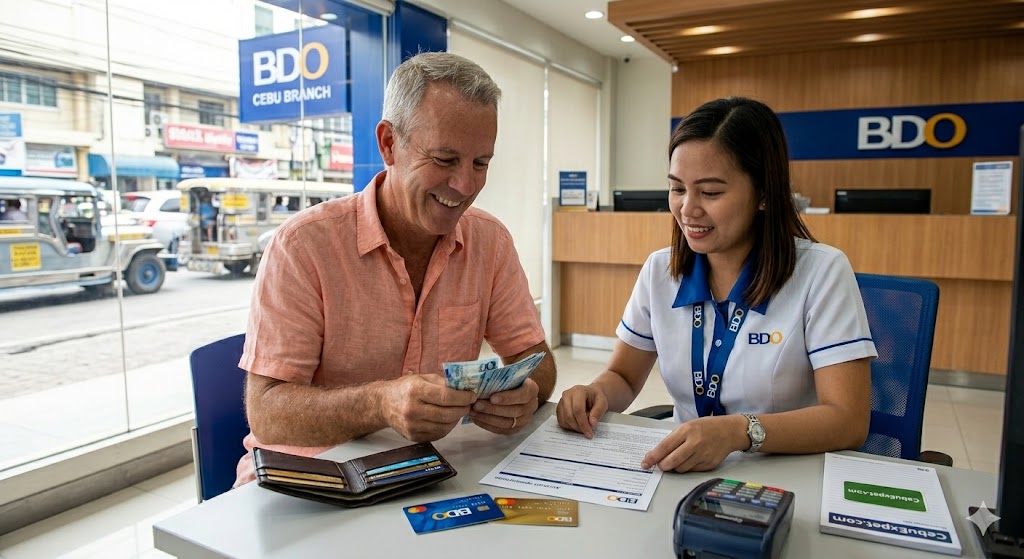
How to Open a Bank Account in Philippines as a Foreigner (2026 Guide)
Foreigners can open a Philippine bank account with a valid passport, current visa, and proof of a local address — no permanent residency required. BDO, Metrobank, and BPI all accept tourists on 9(a) visas. Bring originals and two photocopies of each document. The whole process takes one to two hours at a major urban branch. This guide walks through the exact steps to open bank account Philippines foreigner applicants need to follow — from document preparation to making your first deposit.
Can Foreigners Open a Bank Account in the Philippines?
Yes. The Bangko Sentral ng Pilipinas (BSP), the country’s central bank and financial regulator, permits foreign nationals to open deposit accounts at Philippine banks. There is no citizenship requirement. BSP Circular 706 establishes the framework under which banks may accept foreign clients, and all major commercial banks operate under these rules.
Foreigners on a standard tourist visa (9(a)), a Special Resident Retiree’s Visa (SRRV), a working visa (9(g)), or with an Alien Certificate of Registration Identity Card (ACR I-Card) are all eligible. Even short-stay visitors with as little as two months remaining on their visa are accepted at most major banks, though some banks prefer six months of remaining visa validity as a practical threshold.
The key requirement is a valid visa and a verifiable local address — not permanent residency or citizenship.
Which Banks Accept Foreign Nationals?

Not all banks are equally foreigner-friendly. The table below covers the six banks most commonly used by expats in Cebu, based on branch accessibility, staff familiarity with foreign applicants, and digital banking capability.
Need help opening an account for your Cebu property purchase? Contact our team — we guide foreign buyers through every step of the process.
| Bank | Foreigner Rating | Visa Required | Online Opening | Initial Deposit |
|---|---|---|---|---|
| BDO Unibank | Excellent | Tourist (9a) accepted | No — branch required | ₱5,000–₱10,000 |
| BPI | Good | Tourist (9a) accepted | Partial (app-assisted) | ₱3,000–₱10,000 |
| Metrobank | Excellent | Tourist (9a) accepted | No — branch required | ₱5,000–₱10,000 |
| UnionBank | Good | Tourist (9a) accepted | Yes — via app for some | ₱10,000 (or ₱0 digital) |
| RCBC | Moderate | Tourist accepted at select branches | No | ₱5,000–₱25,000 |
| EastWest Bank | Moderate | Long-stay visa preferred | No | ₱5,000–₱10,000 |
BDO Unibank is the most foreigner-friendly bank in the Philippines by volume of expat accounts. Branches in SM Seaside, Ayala Center Cebu, and IT Park handle foreign applicants regularly. Staff are trained in foreigner KYC requirements and the process is well-documented at the branch level.
Metrobank is equally strong and is a top choice for SRRV retirees. Its Cebu Business Park branch is particularly experienced with expat account openings.
BPI has excellent digital banking and a clean mobile app, but branch staff experience with foreign applicants varies. BPI may require a TIN for certain account types — more on that below.
UnionBank offers the best mobile banking experience in the Philippines and has some accounts openable via its app, making it the top choice for expats who want minimal branch visits after the initial setup.
RCBC and EastWest are viable but less consistent — some branches are very comfortable with foreign applicants while others are not. If you go with either, choose a main urban branch, not a satellite location.
What Documents Do Foreigners Need?
The following documents are required at all major banks. Bring originals and at least two photocopies of each.
Required at all major banks:
- Valid passport — original plus copies of the data page and visa stamp
- Valid Philippine visa or ACR I-Card (must be current — not expired)
- Proof of local address in the Philippines (see options below)
- Initial deposit in cash (₱3,000–₱25,000 depending on bank and account type)
Accepted proof of local address:
- Opening a bank account in Philippines requires signed lease or rental agreement showing your Cebu address
- Hotel confirmation or long-stay booking with your name and address
- Cebu and Barangay sometimes require a certificate of residency (issued same-day at your local barangay hall, typically ₱50–₱100). Obtaining these isn’t difficult. You have to ask for them. Remember, 1 location can be different than another. Asking for help or for a manager will help you.
- Philippines bank account ownership requires a utility bill (electricity, water, internet) in your name at a Philippine address
Documents some banks may request:
- A second government-issued photo ID (home country driver’s license, national ID, or ACR I-Card)
- Source of funds declaration (common for dollar accounts)
- Tax Identification Number (TIN) — required at some banks for certain account types
A note on the TIN: You do not need a TIN to open a basic peso savings account at BDO or Metrobank. However, BPI requires it for some account types, and a TIN is essential if you plan to receive income in the Philippines, invest in time deposits, or purchase property. If you need one, read our guide on how to get a TIN as a foreigner in the Philippines before heading to the bank.
Step-by-Step: Opening an Account as a Tourist or Short-Stay Visitor
If you are on a standard tourist visa (9(a)), follow this process for the smoothest experience.
- Verify your visa has sufficient remaining validity. Most banks want at least two months remaining; BDO and Metrobank are fine at two months but some branches prefer more. If your visa is close to expiry, extend it at the Bureau of Immigration first.
- Get a barangay certificate of residency. This is the easiest proof of address to obtain. Visit your local barangay hall with your passport, pay a small fee (₱50–₱100), and receive the certificate on the spot. It will list your exact address and match your passport name.
- Choose a major urban branch. Go to a high-traffic Cebu branch — BDO Ayala, BDO IT Park, or Metrobank Cebu Business Park. These branches open foreigner accounts daily. Avoid mall kiosks and rural or satellite branches.
- Go on a weekday morning. Aim for Tuesday through Thursday between 9:00 AM and 11:00 AM. Mondays are busy from the weekend, and Fridays see payroll crowds.
- Tell the greeter you want to open an account as a foreign national. You will be directed to a customer service desk, not the teller line.
- Complete the Know Your Customer (KYC) form. Fill in your personal details, source of funds, and account purpose. “Personal savings and living expenses” is entirely acceptable. Be straightforward and consistent with your documents.
- Submit documents and initial deposit in cash. The officer will review everything, make copies, and process your deposit.
- Enroll in online banking before you leave. Ask the officer to help you set up mobile or online banking access while you are still at the branch. This saves a separate trip later.
Total time: one to two hours, including any wait.
Step-by-Step: Opening an Account as an SRRV Holder or Long-Term Resident
SRRV holders have the easiest path of any foreign visa category. Philippine banks treat SRRV holders similarly to permanent residents.
- Use your SRRV visa stamp and ACR I-Card as your primary identification. These documents together are the strongest ID package you can present at a Philippine bank as a foreigner.
- Note the PNB requirement for SRRV deposits. The Philippine Retirement Authority (PRA) requires that the mandatory SRRV deposit — USD 10,000 to USD 50,000 depending on your category — be held at an accredited bank. Philippine National Bank (PNB) is the primary accredited bank for this purpose. This SRRV deposit account is separate from your everyday banking account.
- Open a BDO or Metrobank account for daily use. Your PNB SRRV deposit account is not meant for day-to-day transactions. Open a second account at BDO or Metrobank for spending, bill payment, and receiving funds.
- Dollar account is recommended. If you receive foreign income — US Social Security, pension, overseas rental income — open both a peso and dollar savings account. This simplifies international transfers and preserves your repatriation rights.
- Bring your full SRRV document set. PRA ID, ACR I-Card, passport with SRRV visa stamp, and any supporting residency documents. Banks will make copies of everything.
For a full breakdown of the SRRV program and what it costs to retire in the Philippines, read our guide on retiring in Cebu.
What Type of Account to Open
Peso savings account — the starting point for every expat. Used for daily expenses, bill payments, local transfers, and receiving peso income. Lowest initial deposit requirement.
Dollar savings account (FCDU) — Foreign Currency Deposit Unit accounts allow you to hold USD (and sometimes EUR, GBP, JPY) inside a Philippine bank. Recommended if you receive foreign income or are purchasing property. Required for clean inward remittance documentation on property purchases.
Checking account — useful if you need to issue manager’s checks for large payments (property transactions, large deposits). Not necessary for most expats initially.
Digital/zero-balance accounts — UnionBank’s online account has no maintaining balance requirement and can be opened with minimal deposit. Good as a secondary account for GCash linking, QR payments, and InstaPay transfers.
For most new arrivals: start with a peso savings account at BDO or Metrobank. Add a dollar account once you have a regular income stream or are moving toward a property purchase.
Can You Open an Account Without Being in the Philippines?
For traditional Philippine bank accounts: no. BSP regulations require in-person identity verification for standard deposit accounts at all major banks. You cannot complete the full KYC process remotely.
What you can do before you arrive:
- Gather and organize your documents (passport, visa, proof of address plan)
- Identify your target branch and confirm their current requirements via the bank’s official website
- Set up a Wise or Revolut account from your home country to handle international transfers during the period before your local account is active
UnionBank offers a partially app-based account opening process for some account types that reduces but does not eliminate the need for branch contact. You will still need to verify your identity in person or via a supervised digital process before full account access is granted.
Once you arrive and open your account in person, online and mobile banking can be managed entirely from abroad, including receiving international transfers, paying bills, and monitoring balances.
Using Wise or Revolut Instead: When It Makes Sense
Wise and Revolut are not Philippine banks and are not replacements for a local account — but they are genuinely useful tools for expats in specific situations.
Where Wise excels:
- Sending money from your home country to the Philippines at mid-market exchange rates
- Holding multiple currencies in one account
- Converting USD, EUR, GBP, or AUD to PHP at significantly lower fees than traditional wire transfers
Where Revolut excels:
- Day-to-day spending in multiple currencies while traveling
- ATM withdrawals internationally within monthly limits
- Currency exchange at favorable rates
What neither Wise nor Revolut can do in the Philippines:
- Receive transfers from Philippine bank accounts via InstaPay or PESONet
- Be used as the fund-transfer mechanism for a property purchase (BSP requires a Philippine FCDU or peso account for inward remittance documentation)
- Link to GCash or local Philippine bill payment systems
- Serve as the account for rental income or condo association dues
Recommended approach: Use Wise to move money from your home country into your Philippine bank account during setup, and keep it active for ongoing international transfers. Treat your Philippine bank account as your primary operating account for everything local.
Why You Need a Philippine Bank Account to Buy Property
If buying property in Cebu is part of your plan, a Philippine bank account is not optional — it is a legal and practical requirement.
Inward remittance documentation. The BSP requires that funds used to purchase property by a foreign national be converted through a Philippine bank and documented via a bank certificate of inward remittance. This certificate establishes your legal right to repatriate the equivalent funds when you eventually sell the property. Without it, your capital is effectively trapped in the Philippines.
Developer payments. Pre-selling condo developers require payment via Philippine bank transfer or manager’s check. International wire transfers are technically accepted but create delays and documentation challenges.
Ongoing expenses. Condo association dues, real property taxes, and maintenance fees are paid through local bank transfers. Property management companies remit rental income to Philippine bank accounts.
Title transfer fees. Documentary stamp tax, transfer tax, and BIR Capital Gains Tax payments are processed through government-accredited Philippine banks.
Opening a Philippine bank account — ideally including a dollar savings account — should be among your first three steps when planning a property purchase in Cebu. For the full picture of how the property buying process works as a foreigner, read our guide on how foreigners can buy a condo in Cebu.
FAQ — Frequently Asked Questions
Can a foreigner open a bank account in the Philippines on a tourist visa?
Yes. All five major banks — BDO, BPI, Metrobank, UnionBank, and Security Bank — accept tourist visa holders for standard peso savings accounts. You need a valid passport, a tourist visa with at least two months of remaining validity, and proof of a local address. Go to a major urban branch for the most consistent experience.
Do I need a TIN to open a Philippine bank account?
Not for a basic peso savings account at BDO or Metrobank. A TIN is required at some banks (notably BPI) for certain account types, and it becomes essential if you plan to receive local income, purchase property, or conduct transactions above BSP reporting thresholds. Getting a TIN as a foreigner is straightforward — see our guide on getting a TIN in the Philippines.
What is the minimum deposit to open a bank account in the Philippines as a foreigner?
Initial deposit requirements range from ₱3,000 (BPI basic savings) to ₱25,000 (RCBC premium accounts). BDO and Metrobank typically require ₱5,000–₱10,000 for a standard savings account. Maintaining balance requirements — the minimum you must keep in the account to avoid monthly fees — range from ₱2,000 to ₱10,000, or zero for digital accounts like UnionBank’s online savings.
Can I use my Philippine bank account to receive international wire transfers?
Yes. All major Philippine banks accept incoming international wire transfers (SWIFT). For regular transfers from abroad, a dollar FCDU account is the most efficient — funds arrive in USD and you convert to pesos as needed at the bank’s exchange rate. For lower-fee international transfers, use Wise to convert and send, then receive in your Philippine peso account. Your bank will provide you with the SWIFT code, account number, and branch address needed by the sending bank.
How long does it take to open a bank account in the Philippines as a foreigner?
Opening a bank account at a major Philippine bank typically takes one to two hours at the branch, assuming you have all required documents ready. Account activation — including receiving your ATM card and online banking credentials — takes an additional 3 to 7 business days. BDO and BPI tend to be faster for account setup than smaller rural banks. Opening online is not available to foreigners without an existing Philippine bank account.
Can foreigners open a dollar account (FCDU) in the Philippines?
Yes. Major banks including BDO, Metrobank, and PNB offer Foreign Currency Deposit Unit (FCDU) accounts to foreigners. These are US dollar-denominated accounts and are useful for holding property purchase funds in dollars before converting to peso at the time of payment. FCDU accounts typically require a higher initial deposit (USD 500–1,000) than peso accounts and must comply with BSP foreign currency deposit regulations. An FCDU account is often the recommended first account for foreign condo buyers because it simplifies the BSP-required remittance documentation.
Planning a Move to Cebu?
Opening a local bank account is one of the first practical steps — whether you are arriving for a long stay, pursuing an SRRV, or planning a property purchase in one of Southeast Asia’s most livable cities.
If you are weighing property options, navigating the buying process, or just figuring out where to start, our team works with foreigners at every stage. We can point you toward the right banks, the right neighborhoods, and the right contacts.
Get in touch with our team — no obligation, no sales pressure. Just practical guidance from people who have been through the process.
This guide reflects conditions as of March 2026. Banking requirements and initial deposit amounts are subject to change. Confirm current requirements directly with your chosen bank before visiting the branch. Information provided is for educational purposes and does not constitute financial or legal advice.
For money transfers to and from your Philippine bank account, Wise (formerly TransferWise) offers some of the best exchange rates with no hidden fees — many expats in Cebu use it to fund their local accounts from abroad. The Philippine Statistics Authority (PSA) also publishes official identification requirements that banks may request for account opening.
Leave a Reply